Disease
Bright orange spots on apple leaves: cedar-apple rust
Last reviewed September 2026 · written from Cooperative Extension and university horticulture references — see how we source data
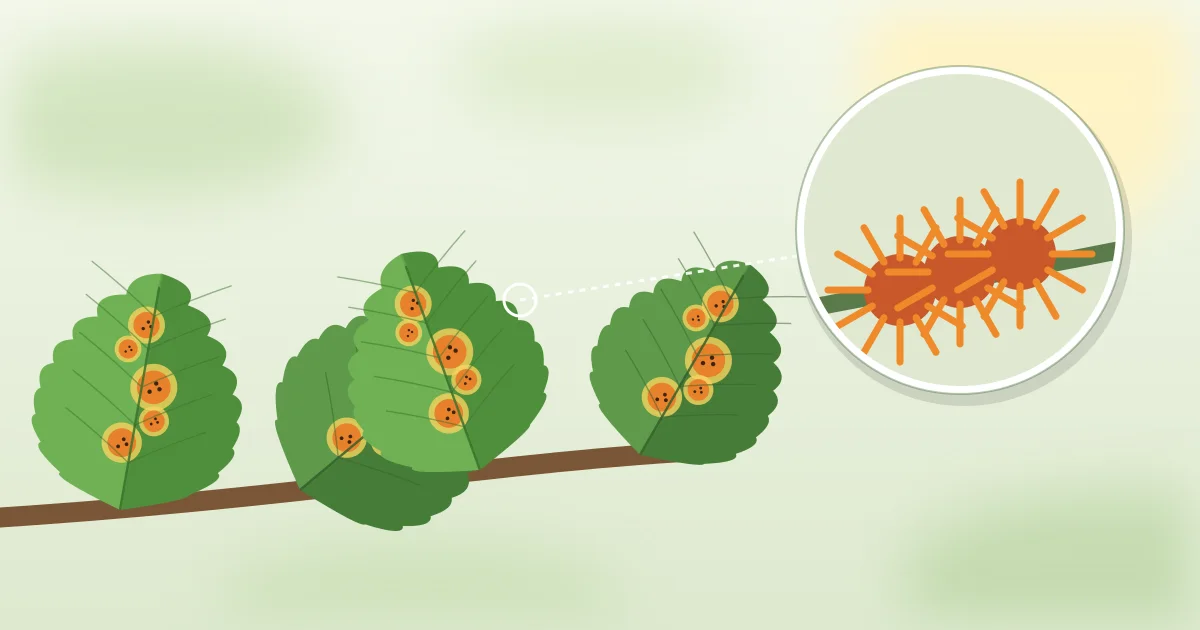
What you’re seeing
Bright yellow-orange spots appear on the upper side of apple leaves in early-to-mid summer, sometimes with small black dots in the center, and matching orange, tube-like growths may appear on the leaf underside; heavily infected leaves can drop early.
Could it be something else?
Likely causes
Ranked most common first.
- A fungus that alternates between two unrelated host plants. This rust genuinely needs both an apple (or crabapple) tree and a nearby eastern redcedar or juniper to complete its life cycle each year - it cannot spread from apple tree to apple tree directly.
- A nearby cedar or juniper with gall growths. In spring, the fungus produces bright orange, gelatinous horn-like growths on cedar galls that release spores carried by wind to nearby apple trees.
- A wet spring. Spore release and infection both depend on rain and humidity around the cedar galls in spring.
How to fix it
- Remove the orange gelatinous galls from any nearby cedar or juniper trees in early spring before they release spores, if the cedars are on your own property and few enough to manage.
- Rake up and dispose of heavily infected fallen apple leaves in autumn to reduce (though not eliminate) local spore pressure.
- Apply a fungicide labeled for cedar-apple rust on the apple tree from bud break through a few weeks after, timed to the spring spore-release period, if this recurs badly every year.
- Accept a mild case with no action - light infection rarely affects fruit yield significantly on an otherwise healthy tree.
Common mistakes
- Spraying once spots appear. Fungicides only protect leaves before infection, from bud break through a few weeks after bloom.
- Planting a highly susceptible variety close to junipers.
- Mistaking a mild case for a crisis. A few spots rarely affect the harvest and need no treatment.
- Confusing rust with apple scab and treating the wrong problem.
When and where it shows up
Spores come from orange, jelly-like galls on nearby eastern red cedar and other junipers after spring rains, around apple bloom. Spots appear on apple leaves in late spring and early summer, and in late summer spores from the apple leaves travel back to the junipers to complete the two-year cycle. Spores can travel a mile or two. It affects apples and crabapples and is common in the eastern and central United States.
Preventing it next time
The most reliable long-term fix is distance and resistant varieties: plant apples at least a few hundred feet from cedars and junipers where practical, and choose rust-resistant apple varieties (Liberty, Enterprise, Redfree) if cedars are unavoidably close by.
Questions gardeners ask
Will cedar-apple rust kill my apple tree?
Rarely. Heavy infections year after year can cause early leaf drop and weaken the tree, but most trees live with it.
Should I cut down nearby junipers?
Usually not necessary or practical, because spores travel a long way. Removing the galls from junipers on your own property in late winter reduces local spores.
Which apples resist cedar-apple rust?
Many modern varieties, including Liberty, Freedom and Redfree, have good rust resistance. Catalogues usually list rust ratings.
Is fruit from a rusted tree safe to eat?
Yes. Occasionally the fruit gets small orange spots, which are cosmetic.