Disease
White powdery coating on pea and bean leaves
Last reviewed September 2026 · written from Cooperative Extension and university horticulture references — see how we source data
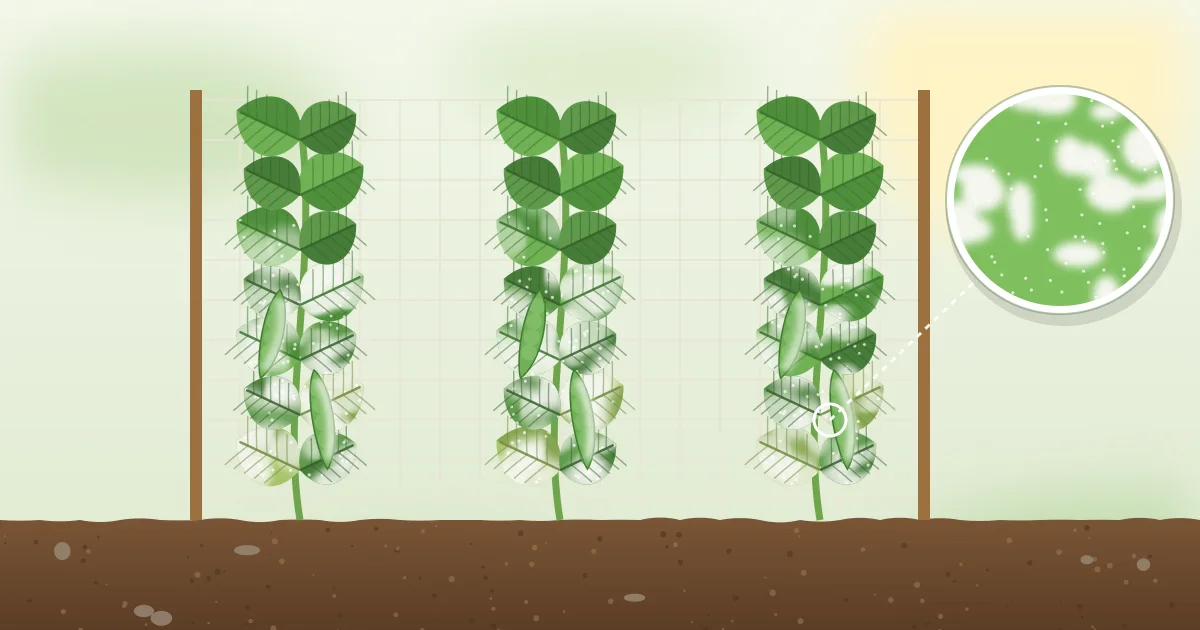
What you’re seeing
A white to grayish powdery coating develops on leaves, stems, and sometimes pods, usually starting on older growth and spreading upward, typically appearing as the weather warms and the planting matures.
Could it be something else?
Likely causes
Ranked most common first.
- Warm days and cool, humid nights late in the season. Like the powdery mildew on squash and cucumbers, this fungus favors the same swing between warm afternoons and cool, humid nights common as spring turns to summer.
- A planting nearing the natural end of its productive life. Peas especially are a cool-season crop that naturally declines as heat arrives, and powdery mildew often shows up right as the planting was going to wind down anyway.
- Crowded plantings with poor airflow. Dense, unsupported vines trap humidity around the foliage and speed up infection.
How to fix it
- Harvest remaining pods promptly, since mildly affected plants can still produce for a little while, but yield and quality decline as infection spreads.
- Remove the most heavily coated leaves to slow the spread if the planting still has useful life left.
- Spray a baking-soda or milk solution (as used for squash powdery mildew) if you want to extend a planting a bit longer, though the return is often modest this late in the crop's life.
- Pull and compost the planting once production has clearly dropped off rather than fighting a losing battle against both mildew and the season.
Common mistakes
- Treating it as a disaster late in the season. On peas it is often just a sign the crop is finishing, and the pods are still fine to pick.
- Crowding rows and trellises, which traps still, humid air around the plants.
- Waiting until plants are white all over before acting. Sprays only protect new growth; they cannot clean up an established infection.
- Sowing peas late into warm weather. Sow early so they finish before mildew weather arrives, and look for varieties labelled 'PM resistant'.
When and where it shows up
On peas powdery mildew is usually a late-season problem. It appears as the weather warms, with dry days and cool, humid nights, often just as a spring crop is winding down; fall-sown peas can get it early in a warm autumn. On beans it tends to appear in mid to late summer. Unlike most fungi it does not need wet leaves to infect, which is why it spreads in dry weather.
Preventing it next time
Provide a trellis or support so vines aren't sprawled and crowded, water at the soil line, and plant peas early enough that most of their productive life happens before the weather turns warm and humid.
Questions gardeners ask
Can you eat peas and beans from plants with powdery mildew?
Yes. The mildew is not harmful to eat. Pods may look dusty - just wash them.
Is it the same powdery mildew that gets squash?
It is a different fungus, because powdery mildews specialise in particular plant families, but it behaves the same way and is managed the same way - see powdery mildew on squash and cucumbers.
Will it spread to my other plants?
Generally not to unrelated crops. The pea and bean mildews will not infect tomatoes or squash, though peas and some other legumes can share it.
Does a milk spray work?
Diluted milk (around one part to two to nine parts water) has reduced powdery mildew on some crops in trials when sprayed weekly as a preventive. Results vary, and it will not clear a heavy infection.