Pest
Stunted plants with swollen, knotted roots: root-knot nematodes
Last reviewed September 2026 · written from Cooperative Extension and university horticulture references — see how we source data
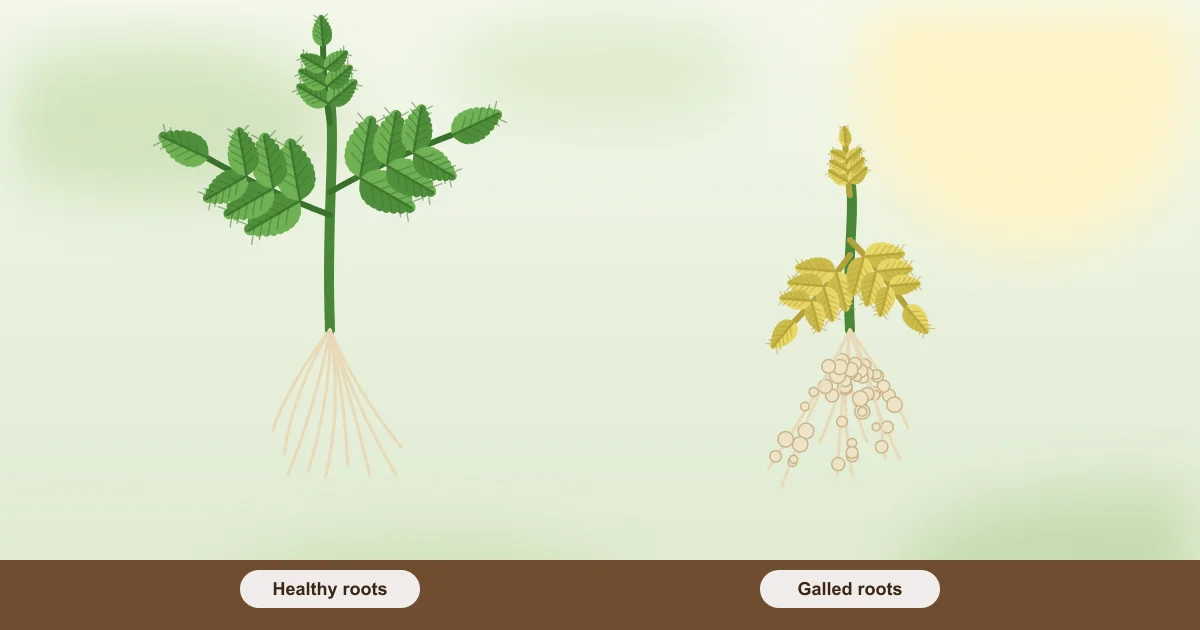
What you’re seeing
Plants that are stunted and wilt in the heat of the day even with adequate soil moisture; pulling one up shows small bead-like galls and swellings along the roots rather than clean, thread-like root growth.
Could it be something else?
Likely causes
Ranked most common first.
- Microscopic soil-dwelling nematodes. These worm-like pests invade root tissue and feed inside it, causing the plant to form galls around the feeding site and lose much of its ability to take up water and nutrients.
- Repeated planting of the same susceptible crops. Tomatoes, carrots, okra and many other vegetables are highly susceptible, and populations build up in soil where they are grown year after year without a break.
- Sandy soil. Root-knot nematodes move and spread more easily through loose, sandy soil than through dense clay.
How to fix it
- Confirm the diagnosis by pulling a struggling plant and looking for the characteristic bead-like galls on the roots - other stresses can cause wilting, but only nematodes cause this specific root swelling.
- Remove and discard (not compost) the roots of infected plants at the end of the season to avoid building up the population further.
- Solarize the bed over a hot summer month by covering bare, moist soil tightly with clear plastic for 4-6 weeks - the trapped heat kills a large share of nematodes in the top several inches of soil.
- Grow a season of French marigolds (Tagetes patula, densely planted and tilled in at the end) or a mustard cover crop in the affected bed; both suppress root-knot nematode populations measurably.
- Rotate to nematode-resistant crops such as corn, most brassicas, and onions for a season or two before replanting susceptible crops in the same spot.
Common mistakes
- Composting infected roots, which spreads the nematodes wherever the compost goes.
- Moving soil from an infested bed on tools, boots or in pots.
- Growing susceptible crops in the same bed every year - see crop rotation.
- Expecting a few marigolds tucked between vegetables to help. Only a dense planting of suitable French marigolds grown for a whole season reduces nematode numbers.
When and where it shows up
Root-knot nematodes are worst in warm, sandy soils in the South and Southeast, in greenhouses, and in beds where susceptible crops are grown year after year. Damage shows most in mid to late summer when the soil is hot. Tomatoes, carrots (forked, hairy, knobbly roots), okra, melons, cucumbers, beans and lettuce are very susceptible.
Preventing it next time
Rotate susceptible crops (tomato, carrot, okra, pepper) through different beds each year rather than repeating them in the same soil, and buy nematode-resistant tomato varieties (marked "N" on seed packets) where nematodes are a known local problem.
Questions gardeners ask
Can I see root-knot nematodes?
No - the nematodes themselves are microscopic. What you see are the galls they cause on the roots.
Do marigolds really control nematodes?
Dense stands of certain French marigold varieties, grown for a full season and then turned in, can reduce root-knot nematodes. Scattered companion marigolds make little difference.
Which vegetables resist root-knot nematodes?
Tomato varieties labelled N are resistant. Corn, most cabbage-family crops, onions and garlic are less affected, which makes them good crops to rotate into an infested bed.
Are vegetables from infested plants safe to eat?
Yes. Nematodes do not affect people - though carrots and other roots may be too misshapen to be worth much.