Environmental
Plants browning and dying near a driveway or walkway after winter
Last reviewed September 2026 · written from Cooperative Extension and university horticulture references — see how we source data
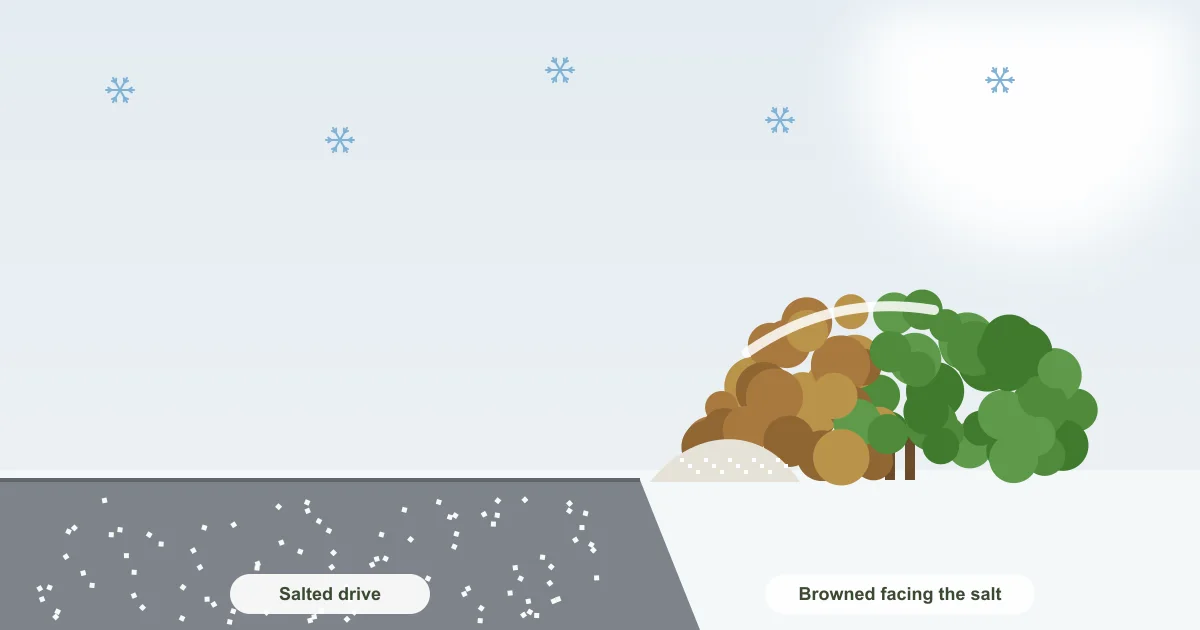
What you’re seeing
Plants near a paved surface that gets salted or de-iced in winter show browning or dead tissue on the side facing the pavement, stunted growth, or fail to leaf out well the following spring, often getting worse in the same spot year after year.
Could it be something else?
Likely causes
Ranked most common first.
- Salt spray from passing traffic or plowing. Salt-laden spray thrown up by vehicles or snowplows lands directly on stems and buds, causing a scorched, one-sided dieback pattern facing the road or driveway.
- Salt accumulating in the soil from runoff. Melting salted snow and ice carries dissolved salt into nearby soil, where it draws water away from roots (the same mechanism as over-fertilizing) and can build up over several winters if it isn't flushed out.
- Repeated yearly exposure. Since salt can persist and accumulate in soil, damage often gets worse each year in the same spot rather than being a one-time event, even if de-icing amounts stay the same.
How to fix it
- Flush the affected soil with a heavy, deep watering in early spring once the ground thaws, which helps leach accumulated salt down and away from the root zone.
- Prune out clearly dead, salt-scorched branches once new growth shows which wood survived, rather than guessing in late winter.
- Switch to a salt-tolerant plant selection for beds directly adjacent to a regularly salted driveway or walkway, since this is a genuinely recurring site condition.
- Use a physical barrier (burlap screening, a snow fence) to block direct salt spray from vehicles or plowing onto vulnerable plants over winter.
Common mistakes
- Shovelling salty snow onto beds and shrubs along the drive.
- Using more de-icer than needed. A coffee mug of salt covers roughly 20 square yards (about 20 square meters) of pavement.
- Planting salt-sensitive crops such as beans, carrots, lettuce and strawberries next to a heavily salted path.
- Adding gypsum and hoping it fixes everything. It can help on clay soils, but flushing with water does most of the work.
When and where it shows up
Damage shows in early spring, when buds fail to open or new leaves come out scorched, on plants within about 10-30 feet of a road and a few feet of a salted driveway or walk. Evergreens show browning on the side facing the road in late winter. Raised beds and vegetable plots placed next to driveways can carry salt for years.
Preventing it next time
Switch to sand, a salt alternative (calcium magnesium acetate), or simply less de-icer near valued plantings, flush the soil each spring, and choose salt-tolerant species for any bed within a few feet of a regularly treated surface.
Questions gardeners ask
Which de-icer is safest for plants?
Calcium magnesium acetate (CMA) is the gentlest, and sand or grit adds traction without any salt. Rock salt (sodium chloride) is the most damaging to plants and soil.
How do I get salt out of garden soil?
Water deeply in spring - about 2 inches of water over a few days on well-drained soil - to leach the salt below the root zone. Good drainage is essential, so add compost to heavy soil.
Is it safe to grow vegetables near a salted driveway?
Keep vegetable beds a few feet back from salted paving and flush the soil each spring. Beets, swiss chard, kale and asparagus tolerate some salt; beans, carrots, lettuce and onions do not.
Will salt-damaged shrubs recover?
Often, if the damage was spray on stems and buds rather than heavy salt in the soil. Wait until late spring, prune out dead wood, and protect the shrub with burlap next winter.