Pest
Squash vine borer and squash bugs: telling them apart
Last reviewed September 2026 · written from Cooperative Extension and university horticulture references — see how we source data
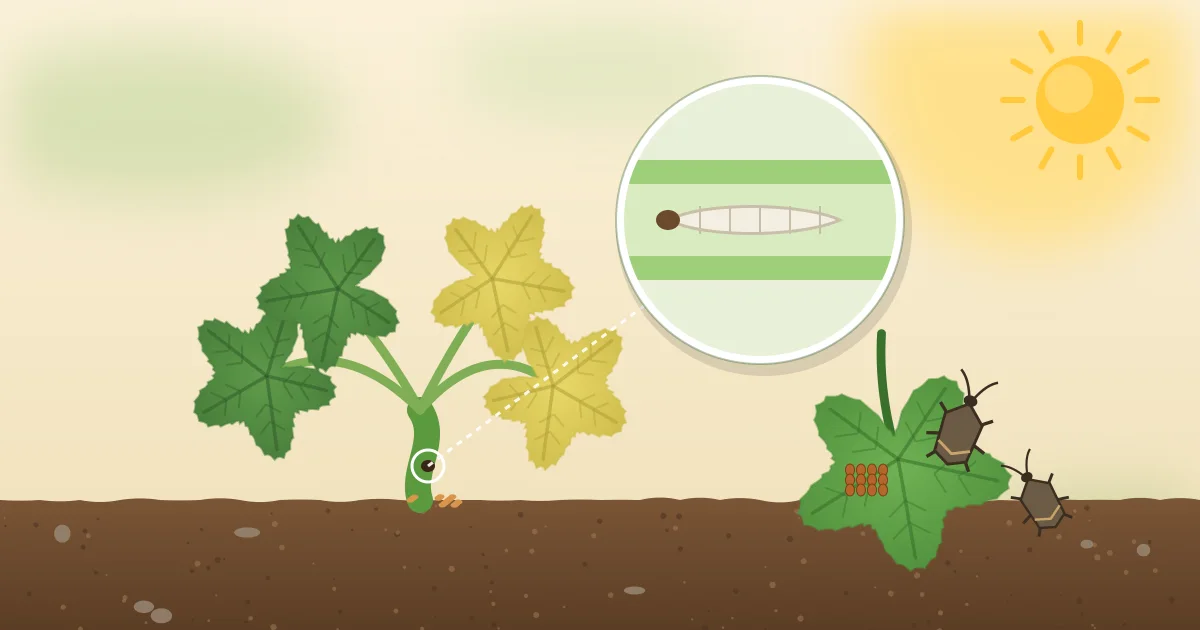
What you’re seeing
Either a previously healthy squash or zucchini vine wilting suddenly at the base with a hole and sawdust-like frass near the stem, or clusters of flat brownish-gray bugs and bronze egg clusters on the undersides of leaves with leaves that yellow and turn crisp.
Could it be something else?
Likely causes
Ranked most common first.
- Squash vine borer. The larva of a clearwing moth tunnels inside the base of the main stem, hollowing it out and cutting off water to the rest of the vine - by the time you see wilting, the damage inside the stem is already done.
- Squash bugs. These true bugs feed by piercing leaves and sucking sap in large numbers, causing yellow speckling that spreads into full leaf collapse; they overwinter as adults in garden debris.
How to fix it
- For vine borer: slit the stem lengthwise near the entry hole with a sharp knife, pick out the white grub, then mound moist soil over the wounded section of stem so it can root and recover.
- For vine borer prevention on new plantings, wrap the lower 6-8 inches of stem in foil or a nylon stocking at transplant time to block egg-laying, and remove it once the vine is thick and woody.
- For squash bugs: check the undersides of leaves weekly for the copper-colored egg clusters and scrape them into soapy water before they hatch.
- For adult squash bugs, hand-pick in the morning while they are sluggish and drop them into soapy water, or lay a board on the ground overnight - they shelter under it and can be collected in the morning.
- Remove and destroy (do not compost) any vine that collapses completely from vine borer damage, since larvae can still complete their life cycle inside a dead stem left in the garden.
Common mistakes
- Taking the first wilt for thirst and watering more. Check the base of the stem for an entry hole and sawdust-like frass before reaching for the hose.
- Composting collapsed vines with larvae still inside, which lets them finish developing in the pile.
- Squashing adult squash bugs but ignoring the eggs. Scrape the bronze egg clusters off the undersides of leaves every few days.
- Leaving boards, debris and old vines around the bed over winter - adult squash bugs shelter under them.
When and where it shows up
Squash vine borer moths - orange and black, day-flying and wasp-like - lay eggs at the base of stems in early to midsummer, and wilting shows two to four weeks later. The borer is mainly a problem east of the Rocky Mountains and on thick-stemmed squash: zucchini, pumpkins and many winter squash. Butternut squash is much more resistant. Squash bugs build up through summer in overlapping generations and are worst from midsummer to fall.
Preventing it next time
Clear old squash debris at the end of the season rather than leaving it over winter, and stagger a second, later planting of summer squash - vine borer damage is often worst on the earliest-planted vines.
Questions gardeners ask
Can a squash plant recover from vine borers?
Sometimes, if you catch it early. Slit the stem lengthways above the entry hole, remove the larva, then bury that section of stem in moist soil so it grows new roots.
Which squash resist vine borers?
Butternut and other squash of the same species (Cucurbita moschata) have harder, more solid stems that borers struggle with. Vining types that root along their runners also survive damage better.
Is a second, later planting worth it?
Often, yes. Sowing zucchini again in early summer, after the main egg-laying period, frequently dodges the first borer generation - see succession planting.
Why do squash bugs smell when crushed?
Like their relatives the stink bugs, they release a defensive odour when crushed. Drop them into a jar of soapy water instead.