Cultural / care
Microgreens growing mold, or barely germinating indoors
Last reviewed September 2026 · written from Cooperative Extension and university horticulture references — see how we source data
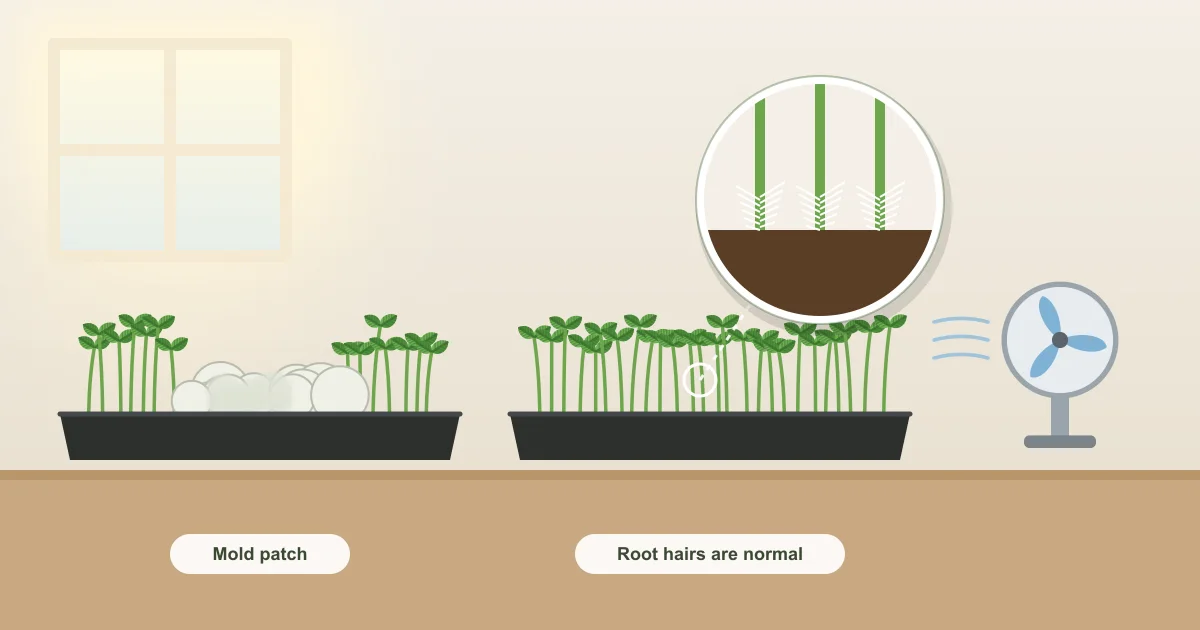
What you’re seeing
Either a white, fuzzy growth appears across the surface of a microgreens tray (sometimes mistaken for the normal fine root hairs many microgreens produce), or seeds fail to germinate at all after several days in otherwise reasonable conditions.
Could it be something else?
Likely causes
Ranked most common first.
- True mold from overwatering and poor airflow. Dense microgreens trays kept constantly wet with no air movement are a near-perfect environment for mold, especially in a humid room or under a clear dome left on too long.
- Normal root hairs mistaken for mold. Many microgreens (especially brassica family ones) grow fine, white, fuzzy root hairs that look alarmingly like mold but are a completely normal part of germination - true mold tends to look more cottony/fuzzy on top of the seed or soil surface rather than at the base of the stem, and often has a musty smell mold-suspicious growth without odor is usually just root hairs.
- Poor germination from old seed, wrong temperature, or seed not kept consistently moist. Microgreens need consistent moisture (not sitting water) during germination, and seed that dried out even briefly in the first day or two often fails to recover.
- Growing medium or seed not pre-soaked when the variety calls for it. Some larger seeds (peas, sunflower, beets) germinate much better and more evenly after an 8-12 hour soak before sowing; skipping this for these types often gives patchy results.
How to fix it
- To tell root hairs from mold: check whether the fuzz is concentrated right at the base of each seedling stem (normal) versus spread across bare soil/medium and seeds that haven't sprouted (more likely mold), and smell for mustiness (mold) versus no smell (root hairs).
- If it is true mold, increase airflow immediately with a small fan, reduce watering frequency, and remove the humidity dome as soon as most seeds have germinated.
- Water from the bottom (setting the tray in a shallow water bath briefly) rather than overhead misting, which keeps the surface less consistently wet.
- For poor germination, check that the growing medium stayed evenly moist (not soggy, not dried out) through the first several days, and pre-soak larger seeds next time per that variety's instructions.
- Start over with a fresh tray and slightly reduced watering if mold has taken hold significantly - it rarely reverses once established.
Common mistakes
- Sowing seed too thickly in layers. A single dense layer is fine; piled seed stays wet and rots.
- Leaving the humidity dome or blackout cover on after most seeds have sprouted.
- Misting the surface several times a day instead of watering from below.
- Reusing trays without washing them, which carries mold spores into the next crop.
When and where it shows up
Mold shows up in the first three to five days, while trays are dense, wet and covered, especially in a warm, humid room with still air. Brassica microgreens such as radish, broccoli and kale have the most root hairs, so they are the ones most often mistaken for mold. Big seeds such as peas and sunflowers germinate patchily if they are not soaked first.
Preventing it next time
Water from below, keep good airflow with a small fan, remove any humidity dome once germination is underway, and pre-soak larger seeds before sowing.
Questions gardeners ask
Is it safe to eat microgreens that had mold?
If true mold has spread through the tray, it is safest not to eat them and to start again with a clean tray. Fuzz that turns out to be root hairs is harmless.
How can I tell root hairs from mold?
Mist the fuzz lightly with water. Root hairs collapse and seem to vanish, while mold stays fluffy. Root hairs also sit evenly around each stem, while mold spreads in patches across the surface and often smells musty.
How long do microgreens take to germinate?
Most brassicas sprout in one to three days; peas and sunflowers in two to four after soaking. Beets and chard can take up to a week.
Do microgreens need light to germinate?
No. Most germinate fine in the dark under a cover, but they need bright light as soon as they sprout, or they turn pale and leggy.