Nutrient
Leaves turning purple or reddish: phosphorus deficiency (or just cold)
Last reviewed September 2026 · written from Cooperative Extension and university horticulture references — see how we source data
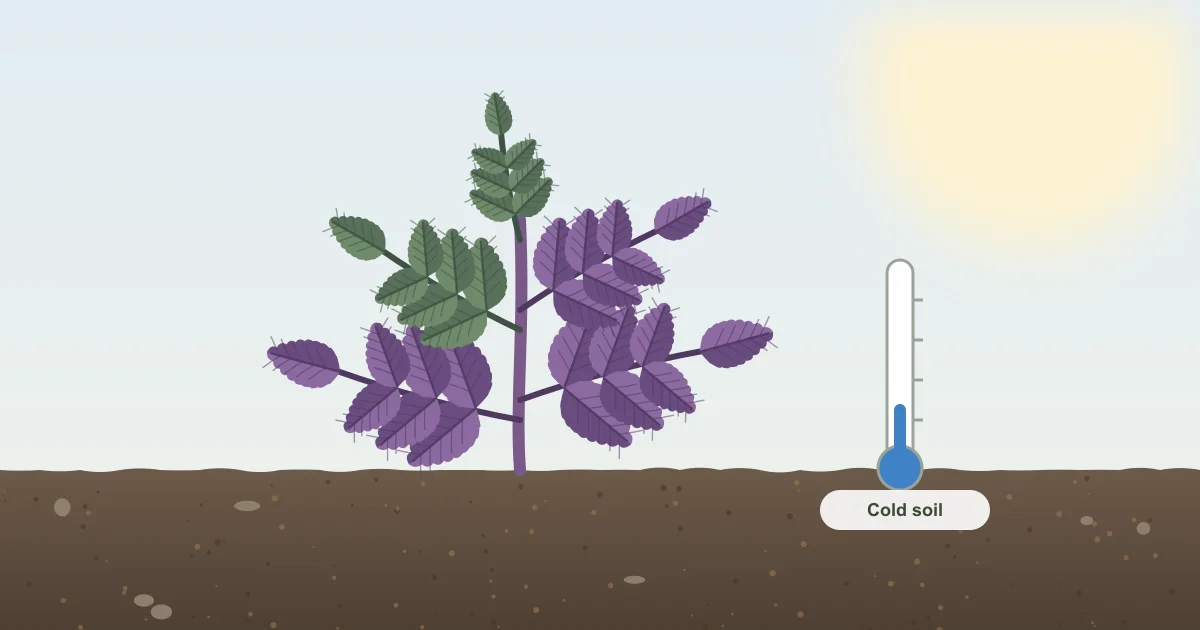
What you’re seeing
Leaves, leaf undersides, or stems take on a dull purple, reddish or bronze tint, often paired with slower-than-expected growth and delayed flowering; older leaves are usually affected first.
Could it be something else?
Likely causes
Ranked most common first.
- Cold soil (the common, harmless cause). Many seedlings and young plants - tomatoes and corn especially - naturally show purple leaf undersides in cool spring soil as a normal, temporary stress response that clears up as soil warms, with no deficiency involved at all.
- True phosphorus deficiency. Persistent purpling that does not resolve as the season warms, combined with genuinely stunted growth and poor root development, points to an actual shortage.
- Low soil pH tying up phosphorus. Phosphorus becomes chemically less available to roots in soil below about pH 6.0, so a pH problem can cause deficiency symptoms even where phosphorus levels in the soil are adequate.
- Compacted or poor root systems. Phosphorus barely moves through soil on its own and has to be intercepted by actively growing roots, so anything limiting root growth (compaction, root damage, cold) limits phosphorus uptake too.
How to fix it
- If it is early spring and soil is still cool, wait it out - this is very often self-resolving purple color from cold, not a true deficiency, and disappears within a couple of weeks as soil warms.
- Get a soil test before adding phosphorus fertilizer specifically, since excess phosphorus does not leach away like nitrogen and can build up to levels that interfere with other nutrients.
- Test and correct soil pH toward 6.0-7.0 if it is testing acidic, since this alone often resolves apparent phosphorus deficiency without adding any extra phosphorus at all.
- If a true deficiency is confirmed, work bone meal or rock phosphate into the soil at planting time, since both are effective slow-release organic sources.
- Avoid disturbing roots further with heavy tilling once symptoms appear, since minimizing root damage helps the plant recover uptake on its own.
Common mistakes
- Adding phosphorus fertilizer without a soil test. Many garden soils already have plenty, and excess phosphorus runs off into waterways.
- Ignoring pH. Phosphorus is locked up in very acidic and very alkaline soils, so correcting pH often fixes it - see soil pH and testing.
- Treating cold-soil purpling in early spring as a disease. It usually clears on its own as the soil warms.
- Planting warm-season crops into cold soil too early in the first place.
When and where it shows up
Purpling is most common in early spring on young tomato transplants, sweet corn and cabbage-family seedlings set out into cold soil, because roots take up phosphorus poorly until the soil warms. Seedlings kept too long in small cells show it too. A true deficiency is more likely in very acidic or very alkaline soil, and in sandy soil low in organic matter.
Preventing it next time
Test soil before each season rather than guessing, keep pH in the 6.0-7.0 range, and mix bone meal or rock phosphate into the planting hole for phosphorus-hungry crops like tomatoes and peppers.
Questions gardeners ask
Will purple leaves turn green again?
New growth comes in green once the soil warms or the deficiency is fixed. The older purple leaves may stay tinted, which does no harm.
Is bone meal a quick fix for phosphorus deficiency?
No. Bone meal releases phosphorus slowly and is largely unavailable in soil above about pH 7. It is a long-term amendment, best used when a test shows a real shortage.
Why are my tomato seedlings purple underneath?
Usually because the growing mix is too cool for the roots to take up phosphorus. Warmer conditions and a weak liquid feed normally green them up - see starting seeds indoors.
Does phosphorus deficiency affect the harvest?
A real, lasting shortage slows growth and delays flowering and fruiting. Brief purpling from cold soil in spring rarely makes any difference to the final crop.