Disease
Brown spots on tomato leaves: early blight vs septoria
Last reviewed September 2026 · written from Cooperative Extension and university horticulture references — see how we source data
What you’re seeing
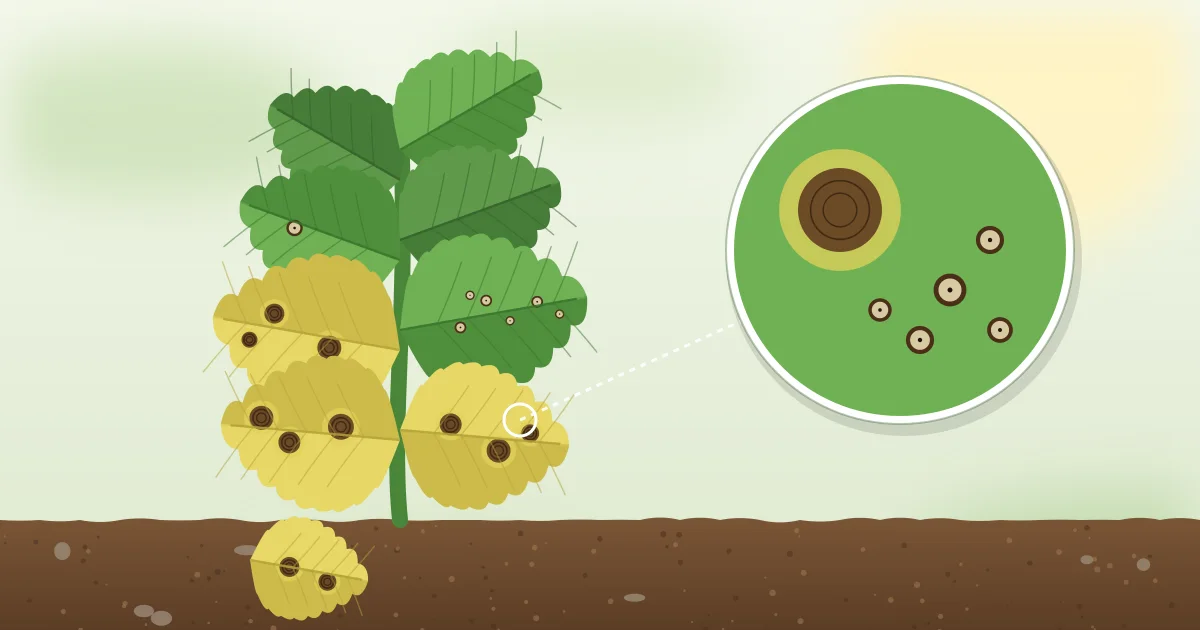
Brown or dark spots on lower, older leaves first, often with a yellow halo, that enlarge and cause the leaf to yellow entirely and drop; the disease works progressively up the plant over the season.
Could it be something else?
Likely causes
Ranked most common first.
- Early blight (Alternaria). Produces target-like spots with concentric rings inside the brown lesion, typically starting on the oldest leaves in early-to-mid summer.
- Septoria leaf spot. Produces many small, uniform circular spots with dark edges and pale tan centers, often with tiny black specks visible in the center of each spot under close inspection.
- Splashing water and humidity. Both fungi spread via water splashed from soil onto lower leaves and thrive when foliage stays wet for extended periods, which is why mulching and drip irrigation matter so much for prevention.
How to fix it
- Remove infected lower leaves as soon as you see them, cutting rather than pulling to avoid tearing healthy stem tissue, and discard them in the trash rather than the compost.
- Mulch around the base of the plant with straw or shredded leaves to stop soil-borne spores from splashing up onto foliage during rain or watering.
- Switch to watering at the soil line rather than overhead, and water in the morning so any wet foliage dries quickly.
- Apply a copper fungicide or chlorothalonil labeled for tomatoes at the first sign of spotting if the disease is spreading fast; these slow new infection but will not cure already-spotted leaves.
- Stake or cage plants and prune for airflow so the lower canopy dries out faster after rain or watering.
Common mistakes
- Composting infected leaves. Home compost rarely gets hot enough to kill the spores, so the disease returns to the beds next year.
- Watering over the top in the evening, which leaves the foliage wet all night - ideal conditions for both fungi.
- Stripping most of the leaves off in a panic. Remove only the spotted lower leaves; the fruit needs the upper canopy for energy and as shade against sunscald.
- Growing tomatoes in the same bed every year, where spores from last year's debris are waiting - see crop rotation.
When and where it shows up
Both diseases appear from early to mid summer, once plants are large and the weather turns warm and humid, and they get steadily worse through wet spells. Septoria often shows first, around the time the first fruit sets; early blight is typical once plants carry a heavy crop. Both start on the lowest leaves, closest to splashing soil, and climb from there. Early blight also attacks potatoes; septoria is mainly a tomato problem.
Preventing it next time
Rotate tomatoes (and their relatives - pepper, eggplant, potato) to a different bed each year since both fungi overwinter in soil and old plant debris, and choose disease-resistant varieties where local pressure is heavy.
Questions gardeners ask
Are tomatoes from plants with early blight safe to eat?
Yes. The leaf spots do not make the fruit unsafe. Early blight occasionally causes dark, sunken patches near the stem end of a fruit - cut those away.
Will early blight kill my tomato plant?
Rarely quickly. It strips leaves from the bottom up, which lowers the yield and can expose fruit to sunscald, but plants that are kept mulched and pruned of spotted leaves usually keep producing through the season.
How can I quickly tell early blight from septoria?
Look at the size of the spots. Early blight spots are larger - up to about half an inch - with rings like a target. Septoria spots are small, about an eighth of an inch, numerous, with pale centres and tiny black dots.
Can I plant tomatoes in the same spot next year?
It is better to wait two or three years. If you have no choice, clear every scrap of old plant debris, mulch thickly before the first rain and choose resistant varieties.