Pest
Tomato hornworms: how to find them and stop the damage
Last reviewed September 2026 · written from Cooperative Extension and university horticulture references — see how we source data
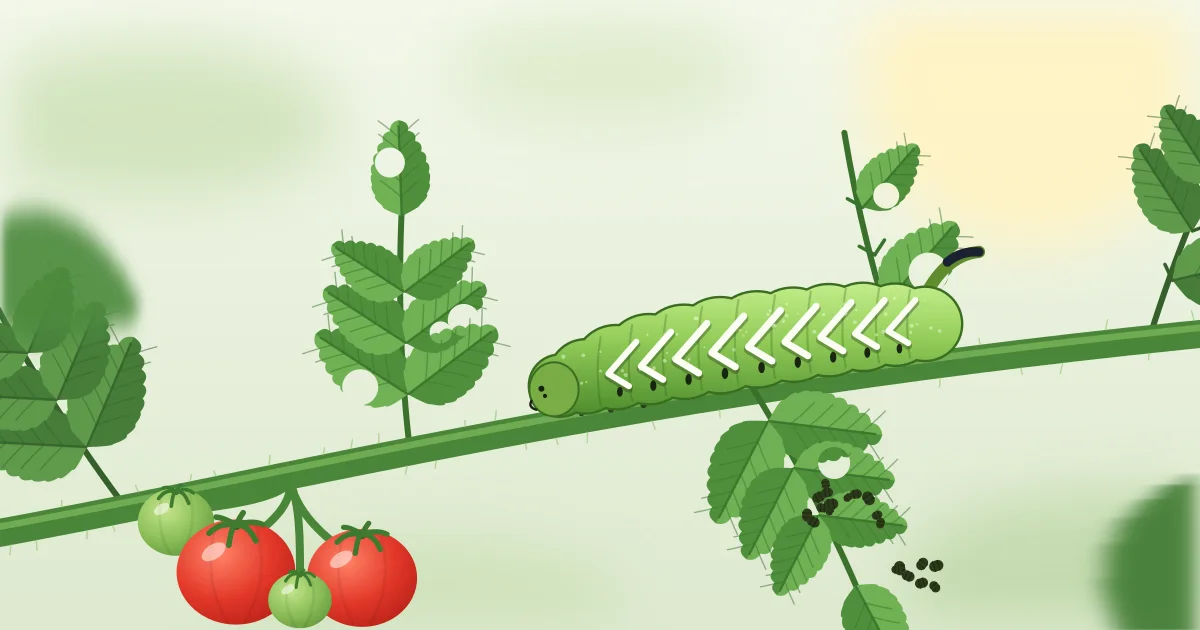
What you’re seeing
Large sections of a tomato plant defoliated seemingly overnight, dark green or black droppings (frass) on leaves below, and often no visible culprit at first glance despite the damage.
Could it be something else?
Likely causes
Ranked most common first.
- Camouflage. Hornworms are the same green as tomato foliage and rest along the stem, which is why the caterpillar itself is usually much harder to spot than the damage it causes.
- Moth activity in early summer. The adult sphinx moths lay eggs on tomato-family plants (tomato, pepper, eggplant, potato) through early and midsummer, so new hornworms can keep appearing for weeks.
How to fix it
- Look at the damage first, then trace downward and outward from the most-defoliated stems - frass droppings on lower leaves usually sit almost directly below the caterpillar.
- Check at dusk or with a blacklight after dark; hornworms fluoresce a pale green-blue under UV light, which makes them far easier to find than in daylight.
- Hand-pick and drop into soapy water, or cut the caterpillar in half with scissors - they do not bite and are harmless to handle.
- Leave any hornworm covered in small white rice-shaped cocoons alone - those are parasitic wasp larvae that will kill the hornworm and go on to control future generations.
- For a bad infestation, Bacillus thuringiensis (Bt) sprayed on foliage is an effective, pollinator-safe option that only affects caterpillars that eat the leaves.
Common mistakes
- Destroying hornworms covered in small white cocoons. Those are braconid wasp cocoons - the wasp larvae are killing the caterpillar, and the next generation of wasps will hunt the rest of your hornworms.
- Spraying broad-spectrum insecticide. It kills the parasitic wasps too. Bt is a better choice because it only affects caterpillars that eat the leaves.
- Looking at the damage instead of below it. The caterpillar is usually a little lower than the freshest bare stems, often right above the heaviest frass.
- Only checking once. New eggs keep hatching through summer - a quick look every few days catches them while small.
When and where it shows up
Hornworms show up from early to late summer, when the adult sphinx moths lay single eggs on the undersides of leaves. They feed on tomatoes, peppers, eggplant and potatoes. The first sign is usually missing leaves near the top of the plant, then dark green droppings on the leaves below. In warm climates there can be two generations a year.
Preventing it next time
Till or turn the soil at the end of the season - hornworms pupate a few inches underground, and disturbing that soil in fall exposes pupae to cold and predators before next year.
Questions gardeners ask
Can a tomato hornworm hurt me?
No. The horn looks threatening but is soft and harmless, and they don't bite or sting. You can pick them off by hand.
What are the white things on the hornworm's back?
Cocoons of a tiny parasitic wasp. The caterpillar is already dying. Leave it on the plant so the wasps can hatch and find more hornworms.
What do hornworms turn into?
The five-spotted hawk moth (or the Carolina sphinx for tobacco hornworms) - big moths that feed on flower nectar at dusk and pollinate as they go.
How much damage can one hornworm do?
A lot. A full-grown hornworm can strip several leaves a day, and two or three can defoliate a young tomato plant in less than a week.