Cultural / care
Brussels sprouts staying tiny or loose and leafy instead of firm
Last reviewed September 2026 · written from Cooperative Extension and university horticulture references — see how we source data
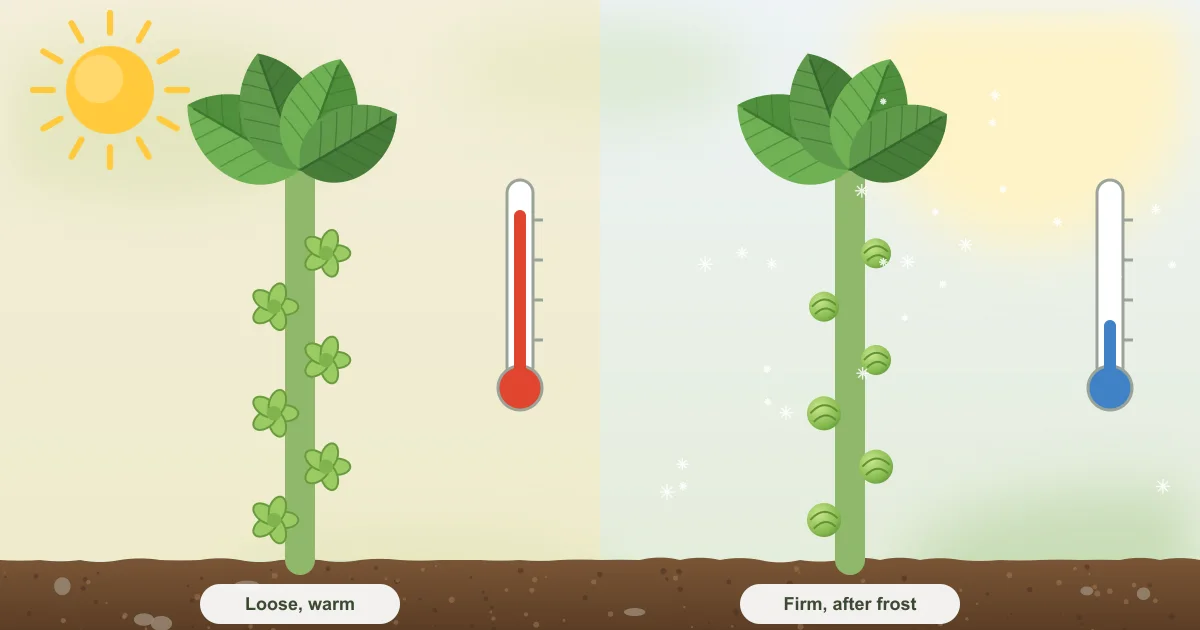
What you’re seeing
The small buds along the stem where sprouts should form stay loose, leafy, and open rather than tightening into firm, round little heads, or they form but stay much smaller than expected.
Could it be something else?
Likely causes
Ranked most common first.
- Warm weather during sprout formation. Brussels sprouts need cool weather (ideally below about 75°F) to form tight, firm heads; heat during the bud-formation stage causes them to stay loose and leafy instead.
- Planted too late for the sprouts to mature in cool weather. This is a long-season crop (often 90-100+ days), and a late planting can hit its sprout-forming stage right as fall cold sets in too hard, or conversely still be forming in summer heat if started too late in spring in a short-fall climate.
- Too little nitrogen, or nitrogen tapering too early. Unlike many fruiting crops, brussels sprouts are heavy feeders that need steady nitrogen through the season to build the size needed for good sprout formation.
- Not topped. Many growers pinch out the growing tip of the plant about a month before expected harvest, which redirects the plant's energy into sizing up the existing sprouts rather than continuing to grow taller.
How to fix it
- Time planting so sprout formation (roughly the last third of the growing period) falls in cool fall weather, which is the single biggest lever for firm heads.
- Feed consistently through the season with a balanced or nitrogen-forward fertilizer, tapering only once sprouts are visibly forming.
- Top the plant (pinch out the growing tip) about 3-4 weeks before your expected harvest date to concentrate the plant's energy into the existing sprouts.
- Harvest what has formed even if smaller than hoped - small sprouts are still perfectly good to eat, just less impressive in size.
Common mistakes
- Planting for a summer harvest in a hot climate. Time planting so the sprouts form in cool fall weather.
- Planting in loose soil without support. Tall plants rock in the wind; firm the soil around them and stake in exposed spots.
- Underfeeding a long-season, hungry crop.
- Picking from the top down. Sprouts mature from the bottom of the stem upward - harvest the lowest ones first.
When and where it shows up
Brussels sprouts form their sprouts in the last third of a long season - often 90-110 days or more from transplanting - and firm up best as the weather cools in fall. Light frosts improve both firmness and flavour. Sprouts that form in summer heat tend to stay loose.
Preventing it next time
Plant so that sprout formation happens in cool fall weather, feed steadily through the season, and top the plant a few weeks before harvest to help sprouts size up and tighten.
Questions gardeners ask
When should I harvest Brussels sprouts?
When the sprouts are firm and about one to two inches across, starting with the lowest ones on the stem. Twist or snap them off, and keep picking upward as they mature.
Does frost improve Brussels sprouts?
Yes. Light frosts make the sprouts sweeter and firmer, so many growers wait until after the first frosts to start picking.
When should I top Brussels sprouts?
Pinch out the growing tip about three to four weeks before you want to harvest. The plant stops growing taller and puts its energy into the sprouts.
Why are my Brussels sprouts loose?
Usually because they formed in warm weather, or the plant was short of nitrogen or water. Loose sprouts are still good to eat - cook them like any other greens.