Growing sea buckthorn
berry / bush fruit
Pollination
Wind-pollinated and dioecious - one male plant for every six to eight female (fruiting) plants.
Growing it
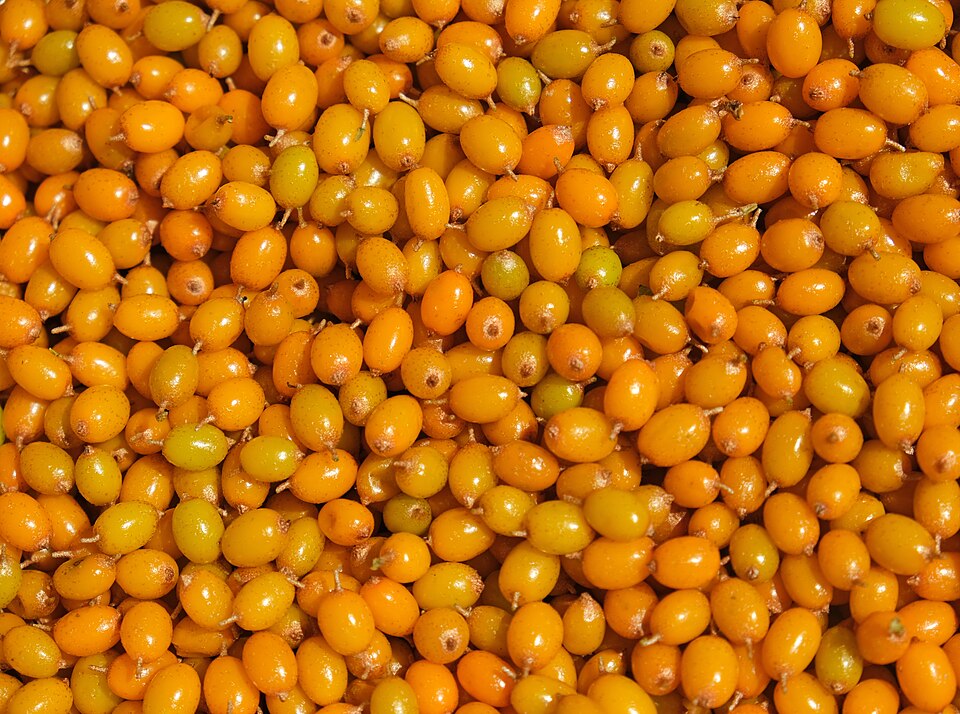
Zones 3-7. Thorny, salt- and drought-tolerant, and nitrogen-fixing. The intensely tart orange berries cling hard - many growers cut fruiting branches and freeze them to strip.
Where sea buckthorn grows best
Hardy in zones 3-7, and it needs enough winter cold - about 600-1200 chill hours - to flower and fruit well. Combining the two:
Good fit across most of: Arkansas, Colorado, Connecticut, Delaware, Idaho, Illinois, Indiana, Iowa, Kansas, Kentucky, Maine, Maryland, Massachusetts, Michigan, Minnesota, Missouri, Montana, Nebraska, New Hampshire, New Jersey, North Carolina, North Dakota, Ohio, Oklahoma, Pennsylvania, Rhode Island, South Dakota, Tennessee, Utah, Vermont, Virginia, West Virginia, Wisconsin, Wyoming. Also parts of Alabama, Alaska, Arizona, California, District of Columbia, Georgia, Mississippi, Nevada, New Mexico, New York, Oregon, South Carolina, Texas, Washington.
Will you get enough chill?
Sea Buckthorn needs roughly 600–1200 hours between 32 and 45 °F over winter to break dormancy evenly. Check your area with the chill hours calculator. Low-chill breeding has pushed many varieties well below the figure here, so read the plant tag.
Questions gardeners ask
What zone does sea buckthorn grow in?
Sea Buckthorn grows in USDA hardiness zones 3-7.
How many chill hours does sea buckthorn need?
Roughly 600-1200 hours between 32 and 45°F over winter, depending on the variety. Low-chill varieties need less - check the plant tag, and estimate your own area with the chill hours calculator.
Does sea buckthorn need a pollinator?
Needs a pollination partner. Wind-pollinated and dioecious - one male plant for every six to eight female (fruiting) plants.
Which states can grow sea buckthorn?
Sea Buckthorn suits most of Arkansas, Colorado, Connecticut, Delaware, Idaho, Illinois, Indiana, Iowa, Kansas, Kentucky, Maine, Maryland and 22 more, and parts of 14 other states where the right zones occur. Your own zone and chill hours matter more than the state.
Chill and pollination are given at the fruit-type level; specific cultivars can differ. Values are typical ranges for home-garden planning.